Enlightened Dragon Principles
Vainqueur the DragonThe Enlightened Dragon Principles are the ideological foundation of Vainqueur’s empire and his claim to have modernized, rather than abandoned, the dragon way of life. Their central transformation is scale: wealth is no longer limited to coins physically gathered in a lair, but includes land, subjects, labor, commerce, tribute, and the institutional power to defend every hoard under his authority. The principles therefore turn draconic greed into a political program, one that is presented as civilization while preserving Vainqueur’s right to rule, consume, and accumulate.
Definition and Imperial Vision
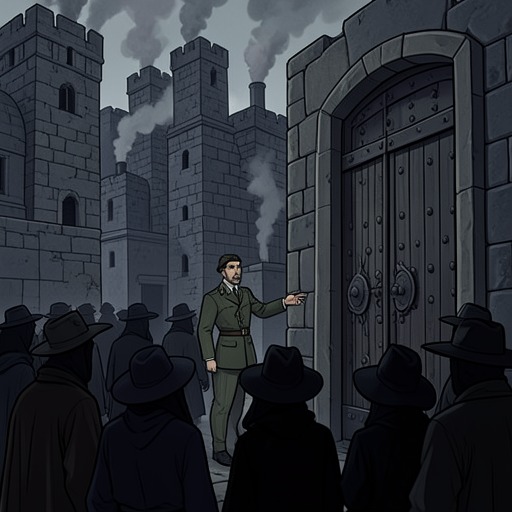
Vainqueur states the doctrine most clearly while displaying the lands around him as proof of his wealth. He declares that he has founded an empire on the Enlightened Dragon Principles: a country where minions never leave his service, even in death; where demons may trade souls without paying taxes to mortals; and where greed itself is law. The formulation joins three systems that would ordinarily be treated as separate: permanent labor, supernatural commerce, and sovereignty. Under Vainqueur’s logic, each is simply another expression of the hoard.
This definition also explains why Vainqueur rejects the comparison with a banker. Banking would reduce his role to managing wealth on behalf of others, whereas he presents himself as the Defender of the Hoard. His authority is founded on possession and protection at once. He claims to have killed Furibon during the First War of the Hoard, defeated the Moth King during the Second War of the Hoard, and uncovered the ancient dragon system that grants him the power to protect the dragon way of life from those who would turn it to lead. The principles thus combine martial achievement, secret knowledge, and economic expansion into a single theory of draconic legitimacy.
From Lair to State
The doctrine depends on making territory legible as treasure. The Castle of Murmurin provides the architectural center of this conversion: it has lava, food reserves, and towers, making it an ideal lair for Vainqueur’s hoard. Outside it, however, the landscape is a harsh frontier of badlands, arroyos, sparse vegetation, a red desert, a small manling village, and primitive encampments. Vainqueur notices that the region was much greener when he flew over it two centuries earlier, but the diminished countryside does not weaken his sense of possession. The castle and its surrounding lands are valuable because he has incorporated them into his imperial hoard.
The principles also require the practical organization of resources. When Victor observes that discarded meat, monster parts, and corpses are simply left for animals, Vainqueur orders him to find a way to make money from this waste. Victor is assigned to open a shop selling junk, monster parts, and corpses, while also serving as chief of staff, preparing Vainqueur’s class progression, and training the Kobolds. This order reveals the doctrine’s economic premise: nothing associated with the hoard should remain unconverted. Waste becomes merchandise, servants become labor, and the dragon’s appetite becomes an administrative and commercial institution.
That institutional logic reaches its most visible form in Nethermart. Bug fiends construct a six-floor, ivory-draped building in the northern part of Murmurin, making it the tallest structure after Vainqueur’s statue. At its grand opening, Malfy presents it as the first fiendish magic-item shop in all of Outremonde, open to monsters and mortals alike. Customers unable to pay in coins may place their souls as collateral, and weapons are offered at a thirty percent discount to celebrate the coming war with Maure. Nethermart therefore embodies the principles as a functioning market: commerce crosses species boundaries, debt reaches beyond death, and military preparation is folded into retail promotion.
Labor, Subjects, and Enforcement
The Enlightened Dragon Principles treat service as a condition that can survive death. Their promise of permanent service is not merely rhetorical, because Vainqueur’s empire openly relies on mass undead labor and soul trading. The system offers a grotesque inversion of ordinary emancipation: death does not release a minion from obligation but makes the labor arrangement more durable. Vainqueur presents this continuity as a benefit to the empire and as evidence that his rule protects the dragon way of life.
The doctrine is also universalizing in its language, though not egalitarian in its practice. During recruitment for the war against Furibon, Vainqueur insists that every creature is equally inferior to him and claims to fight for everyone’s right to become his emergency food. The applicants include one hundred kobolds as well as a troll, a dryad, and a golem. The statement converts discrimination into a mock principle of universal inclusion: all creatures may enter the imperial order, but all remain subordinate to the dragon and potentially consumable by him.
The treatment of the gnolls shows how this order absorbs former enemies and frontier populations. The gnoll tribes had lived under Furibon’s rule, retaining their gold only if they obeyed the lich. After the war, those who remained in the region came to Murmurin seeking work. Vainqueur condemns them for serving Furibon knowingly, then forgives and accepts them into his service. Their incorporation is conditional and coercive: when the gnolls prove lazy, cowardly, or quarrelsome, Vainqueur eats twenty troublemakers before they begin behaving. The principles can therefore accommodate pardon, employment, and political assimilation, but only within a hierarchy enforced by the dragon’s physical power.
Borders, Violence, and Legitimacy
The doctrine’s claims to enlightenment arise against a history of devastated territory and competing forms of rule. Allison explains that the Sablaris were a dark elf empire extending across much of the southern continent, Ishfania, and Barin. Cultists of Sablar the destroyer seized the empire and created a magical cataclysm that transformed it into a red desert in pursuit of universal entropy. Brandon Maure later took control of the ruins of Ishfania with summoned monsters. Vainqueur’s empire enters this landscape not as an untouched kingdom but as a new power claiming the resources and authority left by catastrophe, cultic destruction, and demonic occupation.
The principles consequently require military violence to protect the hoard. The War of the Hoard is framed through the repeated imperative that Furibon must die, while the later imperial self-image rests on Vainqueur’s claim to have destroyed Furibon and the Moth King in successive wars. War is not separate from economics: it secures treasure, establishes territorial ownership, and produces the heroic record through which Vainqueur justifies rule.
After Maure’s army is destroyed and Maure is dead, the political problem changes. Ishfania no longer exists as a nation, but its demon-infested desert still contains enough resources to attract rival powers such as the Eversun Empire, Barin, or Prydain. King Roland proposes that Gardemagne recognize Vainqueur’s claim to Ishfania and treat it as an official adventurer state. In return, Vainqueur must vow that the two countries will never take up arms against each other and will fight together against outside threats. The treaty translates the dragon’s private doctrine into international legitimacy: his hoard becomes a recognized state, and his claim to rule is protected by mutual obligation.
Contradictions and Narrative Function
The Enlightened Dragon Principles are deliberately unstable because their language of enlightenment masks an unchanged appetite for domination. Vainqueur describes an empire where greed is law, undead labor is normal, demons trade souls, and all territory is part of his hoard. The doctrine does not reform greed so much as enlarge its jurisdiction. What appears as political modernization is also the extension of one dragon’s possessiveness into labor law, commerce, military policy, and diplomacy.
Its most revealing contradiction is the gap between protection and exploitation. Vainqueur calls himself the Defender of the Hoard because he has fought threats to treasure and claims to defend the dragon way of life. Yet his defense requires converting other beings into workers, recruits, debtors, commodities, or emergency food. Even the apparent generosity of admitting monsters into his service remains subordinate to his authority, as the gnolls’ survival and employment demonstrate.
The doctrine also gives the surrounding narrative a comic institutional frame. A dragon’s traditional lair becomes an empire; corpses become inventory; souls become collateral; a war becomes a sales event; and a territorial conquest becomes an adventurer state recognized by treaty. Through these reversals, the principles make Vainqueur’s private obsessions appear as public policy. Their significance lies not in offering a coherent ethical philosophy, but in showing how greed can acquire the vocabulary, machinery, and legitimacy of civilization without ceasing to be greed.